Tree and Shrub Disease Treatment in Hooper UT: What Northern Utah Homeowners Need to Do Right Now
The properties along the benchland west of I-15 near Hooper share a common challenge that most homeowners do not connect to their trees until the damage is already visible. The dense, alkaline clay soil that runs through this corridor, the same soil type we work with regularly in West Point, UT, holds moisture unevenly and drains poorly in low spots, creating exactly the conditions that fungal pathogens need to take hold. Add July temperatures that regularly push into the mid-90s, and the combination of heat stress and soil moisture swings makes mid-summer the most dangerous stretch of the year for ornamental trees and shrubs. If you have been putting off tree and shrub disease treatment Hooper UT homeowners have been asking us about, this is the month where waiting starts to cost you.
Tree and shrub disease treatment in Hooper, UT involves identifying active fungal infections, bacterial issues, or insect-driven damage on ornamental and shade trees, then applying targeted treatments to stop spread and support recovery. Most mid-summer cases involve fire blight on flowering trees, powdery mildew on shrubs, or cytospora canker on stressed conifers. Early intervention in July typically preserves the plant. Waiting until August or September often does not.
Key Takeaways
- Mid-July through early August is the highest-risk window for fungal and bacterial disease spread on trees and shrubs in Northern Utah.
- Clay soil and alkaline pH in the Hooper area create drainage and nutrient conditions that weaken trees and make them more susceptible to disease.
- Common diseases in this region include fire blight, powdery mildew, cytospora canker, and verticillium wilt.
- Effective tree and shrub disease treatment Hooper UT requires accurate identification before any product is applied, because the wrong treatment can accelerate damage.
- Sand Dogs Landscaping serves Hooper and the surrounding communities from our base in West Point, with plant and tree services that include disease treatment, insect control, fertilization, and pruning.
What Does Tree and Shrub Disease Look Like Right Now in Northern Utah?
The symptoms showing up on properties this month tend to fall into a few categories, and knowing the difference matters. Fire blight, which hits crabapples, pears, and ornamental flowering trees hard, causes branch tips to curl downward and turn dark brown or black, almost as if the branch was scorched. This is a bacterial disease that spreads fast in warm, humid conditions and can move from one branch to an entire canopy in a matter of weeks if left untreated.
Powdery mildew shows up as a white or gray dusty coating on the upper surface of leaves, most commonly on lilacs, roses, and euonymus shrubs. It rarely kills an established plant outright, but it weakens the plant’s ability to photosynthesize and makes it more vulnerable to secondary problems heading into fall. Cytospora canker is worth watching on spruce and pine trees, showing up as resin-soaked, sunken areas on the bark with yellowing needles on individual branches. Verticillium wilt tends to target maples and other hardwoods, causing sudden wilting on one side of the canopy that can look like drought stress but does not respond to watering.
The reason these diseases are particularly active right now is not just the heat. Irrigation cycles that run too long or too frequently in clay soil keep root zones saturated longer than the plant needs, creating anaerobic conditions that weaken root systems and invite fungal pathogens. If your irrigation system is not calibrated to your soil type, you may be contributing to the problem without realizing it. Our team addresses this frequently when we are out doing irrigation maintenance and repairs, and the connection between overwatering and plant disease is more direct than most homeowners expect. We wrote about similar soil-driven challenges in our lawn care process guide for West Point, and the same principles apply to your trees and shrubs.
Why Is Tree and Shrub Disease Treatment Hooper UT Different From a Generic Spray Program?
This is the question we get most often, and the answer matters. A generic spray program applies the same product on a calendar schedule regardless of what is actually happening on the plant. That approach can suppress some surface-level fungal issues, but it does nothing for bacterial diseases like fire blight, and it can actually mask symptoms of more serious problems like verticillium wilt or root rot until the plant is beyond saving.
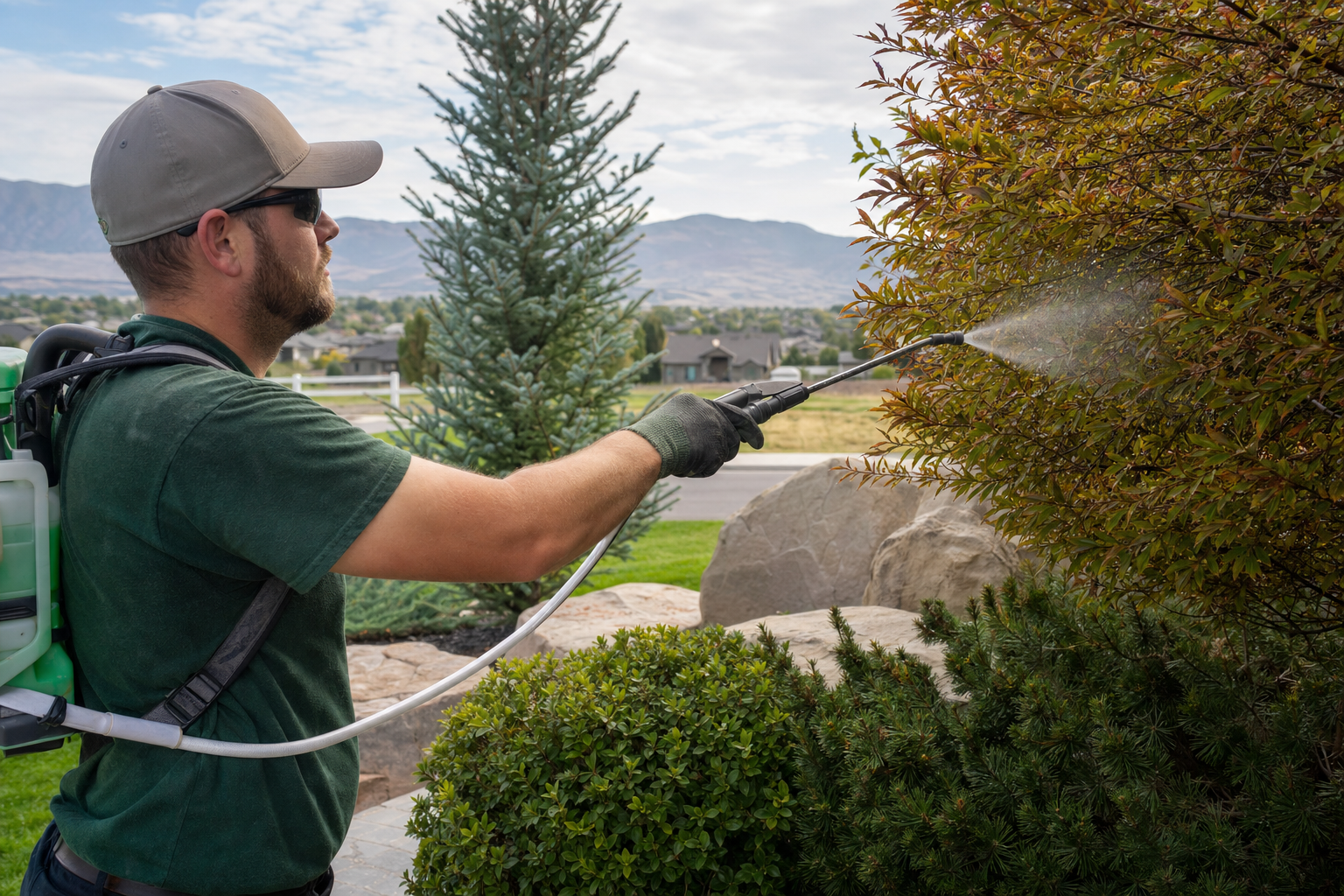
Effective tree and shrub disease treatment Hooper UT requires a site visit and a proper diagnosis first. Our team looks at the pattern of dieback, the condition of the bark, the root zone, and the irrigation setup before recommending any treatment. From there, the plan might include a targeted fungicide application, a bactericide treatment, corrective pruning to remove infected tissue, or a combination of approaches. We also look at whether the plant’s overall health can be supported through plant and tree fertilization, which helps stressed plants build resistance to secondary infection.
For properties in Hooper and neighboring West Haven that have mature shade trees, the stakes are higher. A large cottonwood or maple that has been on a property for twenty or thirty years represents real value, both financially and in terms of the shade and privacy it provides. Losing that tree to a disease that was treatable in July is a preventable outcome, and one our team takes seriously.
What You Can Do This Week Before Calling Us
There are a few things worth doing on your own right now that will help us work more efficiently when we arrive. Walk your property and take photos of anything that looks off, including close-up shots of affected leaves, bark, and branch tips. Note whether the symptoms are on one side of the plant or distributed throughout the canopy, since that pattern tells us a lot about whether we are dealing with a vascular disease or a surface infection. Check whether the affected plants are near a downspout, a low drainage area, or a spot where water pools after irrigation, since those locations are consistently higher risk.
If you have already had landscape maintenance work done this season and noticed something then, pull up those notes or photos. The earlier we can see the progression, the better our diagnosis will be. And if you have trees that were trimmed or pruned recently, let us know, because open cuts made at the wrong time of year can serve as entry points for fire blight and other pathogens.
Frequently Asked Questions
How do I know if my tree has a disease or is just stressed from the heat?
Heat stress typically causes uniform wilting or leaf scorch across the whole canopy, and the plant usually recovers with proper watering. Disease tends to show up in irregular patterns, on specific branches, or with visible signs like powdery coatings, sunken bark, or discolored tissue that does not improve with irrigation. If symptoms are spreading or getting worse over a week or two, that is a strong indicator of disease rather than heat stress alone. A professional assessment is the most reliable way to tell the difference.
Can I treat tree and shrub diseases myself with products from a garden center?
Some surface fungal issues like powdery mildew can be partially managed with over-the-counter fungicides, but the results are inconsistent without knowing the specific pathogen involved. Bacterial diseases like fire blight require bactericide applications timed to the disease cycle, and applying a fungicide to a bacterial infection does nothing. Misidentifying the problem and applying the wrong product can delay effective treatment by several weeks, which in mid-summer can mean the difference between saving and losing a plant.
Does Sand Dogs Landscaping serve Hooper, UT for tree and shrub disease treatment?
Yes. Our team is based in West Point and serves Hooper as part of our regular service area. Tree and shrub disease treatment Hooper UT is one of the plant and tree services we provide throughout Northern Utah, alongside insect control, fertilization, and pruning. You can see our full service area coverage at sandogslandscaping.com/service-areas.
What happens if I wait until fall to have my trees looked at?
For most fungal diseases, waiting until fall means the pathogen has had two more months to spread through the plant’s vascular system or to neighboring plants. Fire blight in particular can move from a few infected branch tips to the main scaffold branches of a tree within a single growing season. By the time leaves drop in October, the damage is done and some plants will not recover. Addressing tree and shrub disease treatment Hooper UT in July gives us the best chance of preserving plants that are still viable.
We are currently scheduling assessments for Hooper and the surrounding area through late July. Once August arrives and temperatures stay elevated, some treatment windows close because applying certain products to heat-stressed plants can cause additional damage. If you have trees or shrubs showing symptoms right now, reaching out this week rather than next gives us the most options. Contact Sand Dogs Landscaping here to get on the schedule before the treatment window narrows further.