Your Backyard Fire Feature Isn’t Working – Here’s What Farmington Homeowners Get Wrong
In West Point, UT, backyards tend to run large and flat, sitting on compacted clay soil that shifts more than most homeowners expect over a single winter. That combination creates a specific problem for outdoor fire features: the ground underneath them moves, and anything built without accounting for that movement eventually shows it. We see this pattern repeat across Farmington, Plain City, and Kaysville, with homeowners who installed a fire pit or outdoor fireplace a few seasons ago now looking at cracked stone, a firebox that won’t draw smoke properly, or a structure that has visibly shifted off level. If any of that sounds familiar, you are not dealing with bad luck. You are dealing with a predictable problem that has a predictable solution. Fire pits & fireplaces Farmington, UT installations fail for consistent, avoidable reasons, and understanding those reasons is the first step toward getting it right.
The frustration usually builds slowly. The feature looks fine at first. Then one spring you notice a crack along the mortar line. By the following fall, the gap has widened. Smoke starts backing toward the seating area instead of drawing up and away. The cap stone on the fireplace shifts slightly. None of it is dramatic at first, but all of it points to the same underlying issue: the foundation beneath the feature was not built to handle the freeze-thaw cycle and clay soil movement that define Northern Utah winters. This is not a cosmetic problem. Left unaddressed, structural movement in a fire feature creates safety concerns alongside the aesthetic ones.
What makes it harder is that fire pits and outdoor fireplaces look straightforward to build. There are kits at home improvement stores. There are tutorials online. But the gap between a fire feature that looks good on day one and one that holds up through five Utah winters is almost entirely in the prep work that happens below grade and in the material and design choices that follow from understanding this specific climate.
Direct answer: Fire pits & fireplaces Farmington, UT projects require frost-depth footings, proper drainage below the base, and materials rated for high heat and freeze-thaw cycles. Without those foundations, clay soil movement and winter frost will crack mortar, shift stone, and compromise the structure within a few seasons.
Key Takeaways
- Clay soil in Northern Utah expands and contracts seasonally, which destabilizes fire features built without adequate footings.
- Frost depth in Davis County reaches roughly 30 inches, meaning shallow bases will heave and crack over time.
- Smoke draw problems in outdoor fireplaces are usually structural, not a fuel or usage issue.
- Material selection matters as much as installation, since not all stone, block, or mortar products are rated for repeated high-heat exposure.
- A properly installed fire feature integrates with the surrounding hardscape and drainage plan, not just the ground it sits on.
What Actually Causes Fire Features to Fail in Northern Utah?
The short answer is frost and clay. Davis County’s frost depth sits around 30 inches, which means any footing that does not extend below that line is sitting in soil that will freeze solid in winter and thaw in spring. That cycle exerts significant upward pressure on whatever sits above it. For a fire pit or outdoor fireplace, that pressure translates directly into cracked mortar joints, shifted capstones, and bases that are no longer level.
Clay soil compounds the problem. Unlike sandy or loam-based soils, clay holds moisture and swells when wet, then contracts as it dries. Farmington and West Point properties built on clay-heavy ground see this movement play out every year. A fire feature installed directly on a shallow gravel bed or an insufficiently thick concrete pad will follow that movement. Over two or three seasons, the cumulative shift becomes visible and eventually structural.
Heat cycling adds a third layer of stress. Fire features expand when hot and contract when cool. If the materials used are not rated for that thermal movement, or if the mortar mix was not appropriate for high-heat applications, the joints fail from the inside out regardless of how solid the base is. We have seen installations where the base was done correctly but the wrong mortar was used, and the firebox itself cracked within a single season of regular use.
Why Is This Especially Common in the Farmington and West Point Area?
The geography here creates a specific set of conditions. Properties along the Wasatch Front bench, including much of Farmington, sit on ancient lake bed soils from Lake Bonneville. Those soils are fine-grained, moisture-retentive, and prone to significant seasonal movement. West Point and Plain City properties closer to the valley floor deal with similar conditions, often with higher water tables that add moisture to the soil equation year-round.
The summer heat in August also plays a role. A base that looks perfectly level in August may reveal movement issues by the following March. That seasonal timing is one reason we always account for the full annual cycle during design, not just the conditions present at installation.
For homeowners in Kaysville and Hooper, the same soil and frost conditions apply. The problems we see with fire pits & fireplaces Farmington, UT installations are not isolated to one zip code. They follow the soil and climate patterns that define the entire region.
What Mistakes Should You Avoid Before Starting a Fire Feature Project?
The most common mistake is treating a fire pit as a surface-level project. Digging a shallow hole, filling it with gravel, and setting block on top is not a foundation. It is a temporary arrangement that will shift. Any fire feature meant to last needs a proper concrete footing that extends below the frost line.
Skipping drainage planning is the second major error. If water pools near the base of a fire feature, it accelerates both frost heave and mortar deterioration. A well-designed installation accounts for how water moves across the surrounding area, which ties directly into broader hardscape and drainage planning.
Using standard mortar instead of refractory mortar inside the firebox is another mistake that shows up repeatedly. Standard mortar cannot handle sustained high heat and will crack and crumble at the firebox level. The outer structure and the inner firebox require different materials, and conflating them is a shortcut that costs more to fix than it saved at the start.
Finally, ignoring the relationship between the fire feature and the surrounding patio or walkway creates problems. If the patio shifts and the fire feature does not, or vice versa, you end up with uneven transitions that are both a tripping hazard and a visual problem. These elements need to be designed and built as a system.
Fire Pits & Fireplaces Farmington, UT: What the Right Installation Actually Looks Like
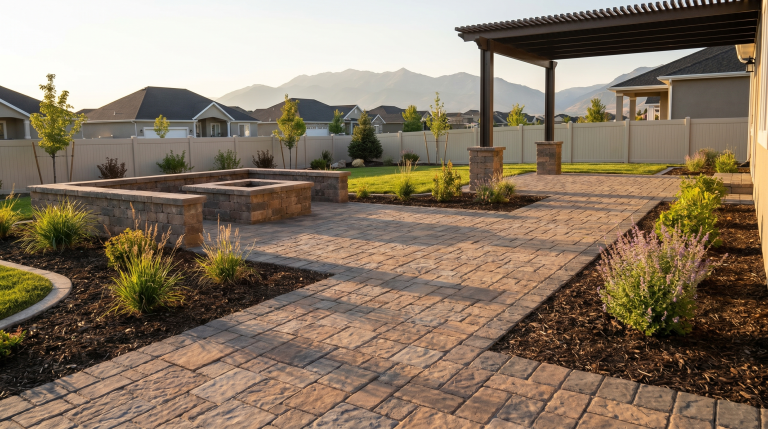
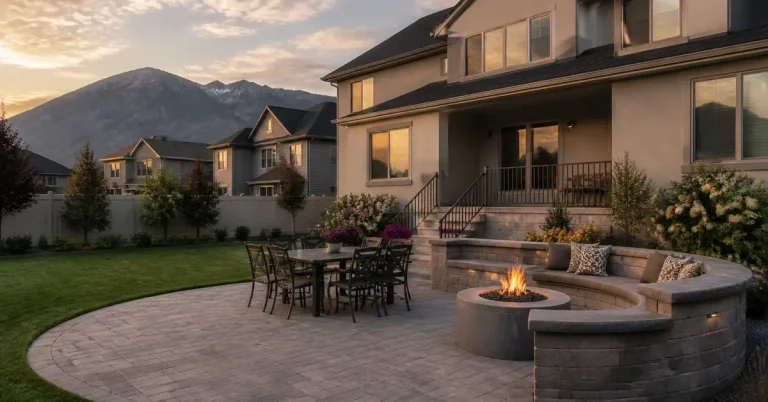
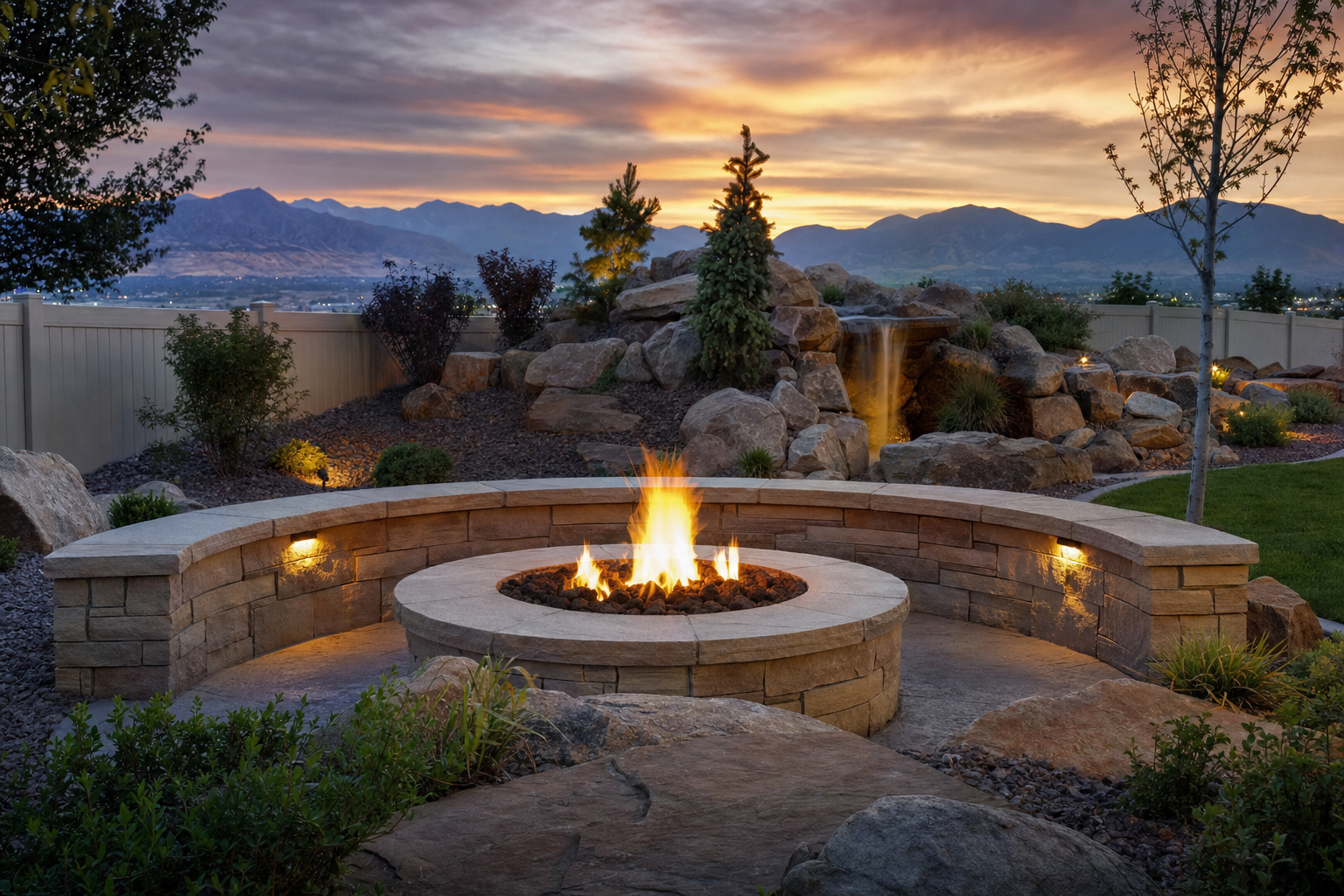
A properly built outdoor fire feature in this climate starts with excavation to below the frost line and a poured concrete footing that is sized for the weight and footprint of the structure above it. From there, the base materials are selected for both structural load and drainage. The firebox is built with refractory materials rated for the heat levels that fire features actually reach in regular use. Capstones and veneer materials are chosen for freeze-thaw durability, not just appearance.
The surrounding area matters too. We typically integrate fire feature installations with the broader hardscaping plan for the yard, making sure the patio surface, any retaining elements, and the fire feature itself are all working from the same grade and drainage assumptions. That coordination is what separates a fire feature that holds up from one that starts showing problems in its second or third season.
Pricing for this type of work depends entirely on the scope, the materials selected, and the existing conditions on your property. A custom estimate based on your specific property is the only accurate way to approach it.
When Should You Call a Professional Instead of Attempting This Yourself?
If you are looking at an existing fire feature that has already cracked, shifted, or started drawing smoke incorrectly, that is the point where professional assessment is the right move. Continuing to use a structurally compromised fire feature is a safety concern, not just an aesthetic one. Cracked fireboxes can allow heat to transfer to surrounding materials in ways that were not intended in the original design.
For new installations, the footing and drainage work alone require equipment and material knowledge that go beyond what most homeowners have on hand. Getting those elements wrong means rebuilding from the ground up, which costs significantly more than getting it right the first time. Fire pits & fireplaces Farmington, UT projects that start with proper planning and professional installation simply last longer and perform better through the Northern Utah climate cycle.
If you are ready to talk through what a fire feature project would look like on your specific property, reach out to our team for a custom assessment. We work across West Point, Farmington, Kaysville, Hooper, and Plain City, and we know what these soils and winters require.
Frequently Asked Questions
How deep does a footing need to be for a fire pit or outdoor fireplace in Farmington, UT?
In Davis County, the frost depth is approximately 30 inches. Any concrete footing for a fire feature should extend to or below that depth to prevent frost heave from shifting or cracking the structure. Shallow bases are the single most common reason fire features in this area fail within a few seasons.
Can I install a fire pit on an existing patio in West Point or Farmington?
It depends on what the existing patio is built on and how it was constructed. A patio slab that was poured without adequate depth or reinforcement may not support the concentrated weight of a fire feature without cracking. We assess the existing conditions before recommending whether to build on the current surface or excavate and start fresh.
Why does smoke blow toward the seating area instead of drawing upward?
Smoke draw problems in outdoor fireplaces are almost always structural. The firebox opening ratio relative to the flue size, the height of the chimney, and the surrounding wind patterns all affect draw. In some cases, a shifted structure has altered the geometry of the firebox opening, which changes how air moves through it. This is not something that adjusts itself over time and typically requires a structural assessment.
Do fire pits & fireplaces Farmington, UT installations require a permit?
Permit requirements vary by structure type and municipality. Permanent outdoor fireplaces with a chimney are more likely to require a permit than a simple ground-level fire pit. We recommend checking with Farmington City or Davis County building departments before beginning any permanent fire feature installation, and our team can help you understand what the project scope involves before you make that call.